


Social media at the epicenter of our society has transformed where consumers meet to a buying platform. As feeds become more personalized and content mixes inspiration with commerce, platforms like Instagram and TikTok are altering the journey from discovery to purchase.
The shift is particularly evident among younger consumers. GWI’s latest data shows that search engines remain the number one source for product research around the world, with 50% of consumers using them, versus 45% for social media. Among Gen Z, however, the balance has shifted: 50% use social networks to research products, compared with 45% who use search engines.
Fashion is leading this change, with Gen Z at the forefront of a shift in how consumers discover, evaluate, and engage with fashion. As a generation deeply immersed in social media, Gen Z is not only consuming fashion content but also actively shaping the trends, aesthetics, and purchasing behaviors that influence the wider industry. A February 2025 eMarketer study found that US Gen Z consumers were most likely to discover products on Instagram (30.4%), followed by TikTok (23.2%) and Google (18.8%). This highlights how social platforms have become an increasingly important part of Gen Z’s fashion journey, giving brands a valuable window into the preferences and behaviors of a generation that is increasingly influencing the direction of fashion.
Social media is more than a marketing channel for brands. Products starting to get visibility, esthetics crossing communities and audiences adopting them first can be signs of where demand is headed. When analyzed at scale, these signals allow brands to move from merely spotting trends to understanding who is driving them, where they are gaining traction, and how they might evolve.
Social media-based trend forecasting
So if consumers can glean so much from their favorite brands on Instagram, why shouldn’t brands be able to do the same by learning from their customers?

Using data drawn from social media, brands can gain a deeper understanding of their audiences, from geography, age, and interests to values, style, and more. At Heuritech, we take this a step further by identifying emerging trends and products within the data we collect from Instagram. By combining consumer insights with trend intelligence, brands can gain a powerful edge in collection development, using social media as a source of real-time market insight. But how does it work?
Left: Images from Heuritech’s database
Defining consumer segments on social media
The first step in Heuritech’s forecasting process is to define consumer panels, or segments, based on social media data. We identify three main consumer panels: trendsetters, early adopters and mainstream.


Images taken from Heuritech’s database, by consumer panel
- Trendsetters: These consumers adopt a look or product far before it arrives on the popular radar, and they seek styles from small or emerging brands.
- Early adopters: These consumers keep up with new and desirable brands, styles, and products and tend to wear trends when they’re at the peak of their popularity.
- Mainstream: These consumers follow along with major styles and products once they’ve reached peak popularity and engage more passively in fashion.

These three panels are built from tens of thousands of public accounts on Instagram, either hand-picked or identified using AI, and are regularly updated to exclude inactive or irrelevant accounts.
Each panel includes tens of thousands of public accounts across the geographies we cover, alongside millions of images from Xiaohongshu (Little Red Book), China’s leading platform for fashion discovery, with over 300 million monthly active users. By analyzing millions of images and consumer signals from Xiaohongshu each month, we capture early fashion signals as they emerge and spread among Chinese consumers, often before they become visible to brands outside the market. This gives brands direct access to hard-to-source insights and emerging trends from the Chinese market.
Applying our image recognition technology to social media images
Once we’ve defined and refined our consumer panels, we move on to analyzing the images themselves to identify trends, styles, and products. Heuritech does this using our in-house computer vision technology, developed by our two co-founders, AI experts Tony Pinville and Charles Ollion. To maintain a high level of accuracy, our data experts continuously refine and improve the technology.

We apply this technology to each image, analyzing everything from color, shape, and fabric to prints and patterns. Our computer vision technology can identify more than 2,000 details in a single image, which can then be cross-referenced with consumer segments, geography, and seasonality.
Our current scope covers Clothing and Shoes:
- 6 Clothing categories: Tops, Dresses, Skirts, Pants, Shorts, Outerwear
- 6 Shoes categories: Sneakers, Boots, Dress Shoes, Sandals, Casual Shoes, Hybrids
Within each category, we can detect highly specific product attributes. For example:
- Outerwear: Shapes, fits, hood types, lengths, pocket types, and more
- Dress Shoes: Shapes, back types, closures, heel heights, heel types, toe shapes, and more
Beyond product-specific attributes, we also identify macro trends that can be tracked across categories, including:
- Colors: Warm tones, beige, pastel pink…
- Fabrics: Leather, knit, ribbed knit…
- Prints & patterns: Dots, animal, leopard…
For example, our experts identified Thong Sandals as an emerging trend among our trendy consumer panel for Summer 2026 in Europe. First spotted by our fashion experts, the trend was then validated and quantified using historic and real-time data from our AI technology.
This combination of expertise and AI-powered data is what allows Heuritech to accurately identify and analyze niche and emerging trends. With around 120 million posts in our Trend Forecasting platform alone, our experts and technology have a vast pool of data to uncover what is emerging and what is gaining momentum.
Forecasting trends with accuracy
To transform raw data into useful information for the market, Heuritech applies a proprietary forecasting toolkit with seven different algorithms. This technology allows brands to recognize patterns, predict changes in consumer behavior, and forecast trends with up to 90% accuracy. By understanding how trends evolve over time, brands can see emerging opportunities more clearly and make better decisions.
Actionable analysis with social media based trend forecasts
The final step in our social media based trend forecasting is delivering actionable data. To succeed in a competitive industry, fashion brands need advanced tools to interpret insights from platforms like Instagram or Xiaohongshu and apply them to their strategies. This analysis empowers companies to make decisions based on evidence, aligning their collections and marketing with real market changes.
Our metrics include, but are not limited to:
- Consumer segmentation: trendsetters, early adopters and mainstream panels help brands deepen their understanding of customer behavior and target specific audience interests to refine their positioning.
- Geography: Trend and product data is specific to each market region (Europe, US, China, Brazil, etc.), allowing businesses to adapt their strategies to regional shifts and cultural patterns.
- Seasonality: Insights on optimal launch times ensure companies capture emerging trends to drive sales and avoid investing in declining styles.
- Growth: Tracking visibility over time allows research teams to identify popularity changes compared to previous years, securing long-term growth.
- Magnitude: Evaluating potential market volume helps brands anticipate the future scale of a trend for better inventory decisions.
- Age segmentation: Analysis of adoption rates across age groups (16-45+) clarifies which demographics will drive the trend, aiding precise product design.
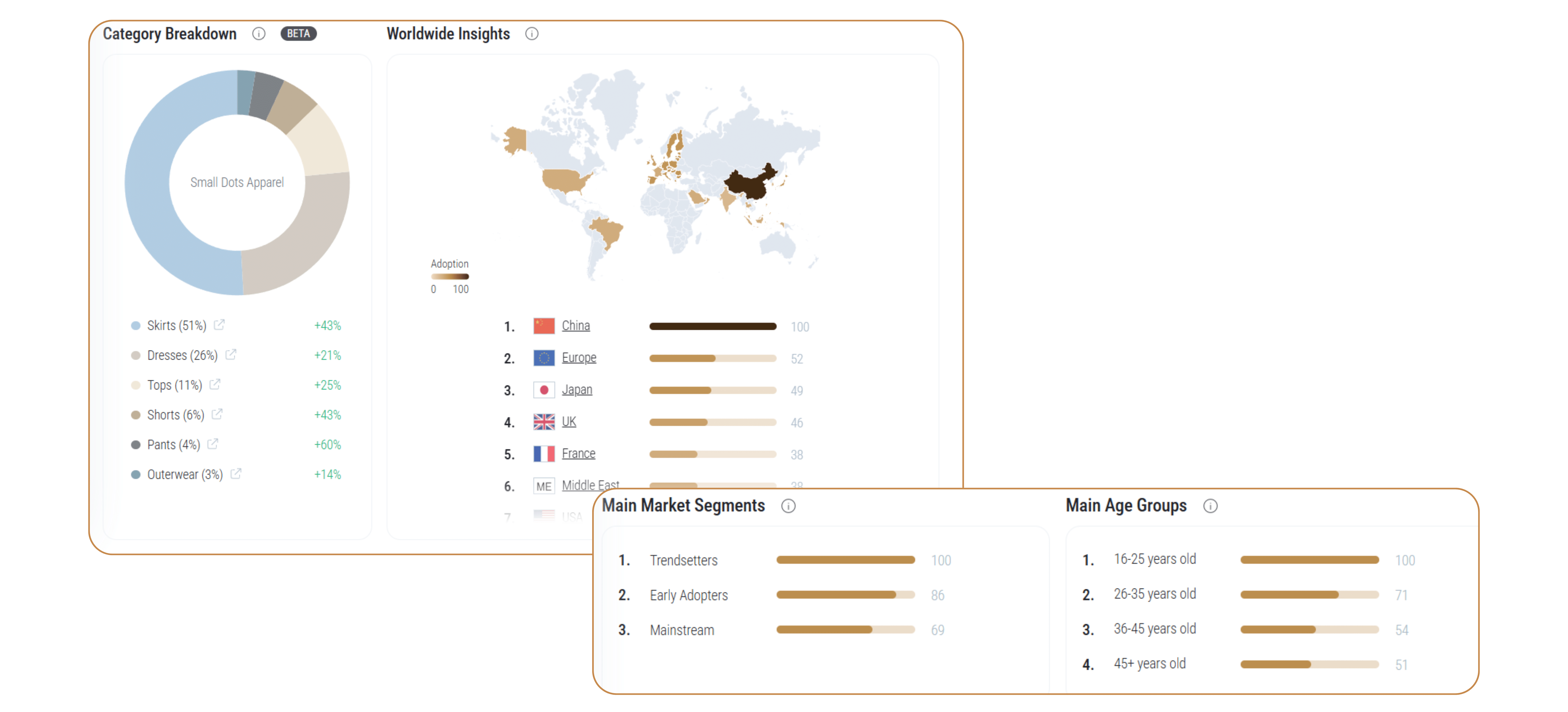
Heuritech’s platform, demonstrating metrics breakdown
Beyond these metrics, we provide inspirational examples and moodboards to support innovation and design. This combination of qualitative and quantitative research offers a 360° view of industry changes that might be missed by a simple manual search. With this strategic intelligence, brands can better understand consumer needs and ensure sustainable business growth.
AI and human expertise makes the power of our trend forecasting
At Heuritech, we pride ourselves on integrating cutting-edge artificial intelligence with deep fashion expertise to deliver predictive analytics with unparalleled precision. Our dedicated team consists of machine learning specialists who continuously improve our algorithms. Alongside them, our fashion analysts and forecasters bring industry insight and intuition, enabling us to contextualize the data and identify trends that are not just statistically relevant but also culturally resonant. This synergy between AI and human expertise allows us to deliver accuracy in trend forecasting, setting a new standard for the industry.
For fashion brands, social media is a true gamechanger for consumer insights. The numbers alone are impressive: as of January 2026, Instagram reported at least 3 billion users monthly around the world. The sheer volume of users globally is evidence enough of the goldmine of data within these platforms, providing new, unfiltered insights each day.

Indeed, consumers express their favorite styles and their strongest values intuitively, through posts, likes, and hashtags that reflect their honest opinion. This is the major advantage of social media based trend forecasting: the data we pull from Instagram, Xiaohongshu, and more is taken directly from the source: the consumer.
These insights are unbiased, reliable, and in real-time. Instinctive information like this offers brands data on what consumers do, rather than simply what they say, which is often what we find in typical consumer sources such as social listening and organized surveys.
To access data which reveals how a certain product is performing on the market, or how a type of consumer feels about a particular trend, or even how a certain style is being adopted in one geography versus another, these insights are truly invaluable for a brand, big or small. With the power of artificial intelligence and human expertise, it’s possible to demystify the market and create better collections.


